Shipping containers are more than storage — across California they’ve become flexible platforms for offices, retail pop-ups, cafes, construction site trailers, event booths, and even small ADUs in places where zoning allows. This article showcases 10 high-value business use cases, highlights typical modification choices (insulation, HVAC, roll-up doors, electrical), provides rough cost bands for each conversion type, and points out the regulatory and site-prep considerations California businesses should plan for before buying or modifying a container.
Use Case 1 — Mobile construction office / project hub
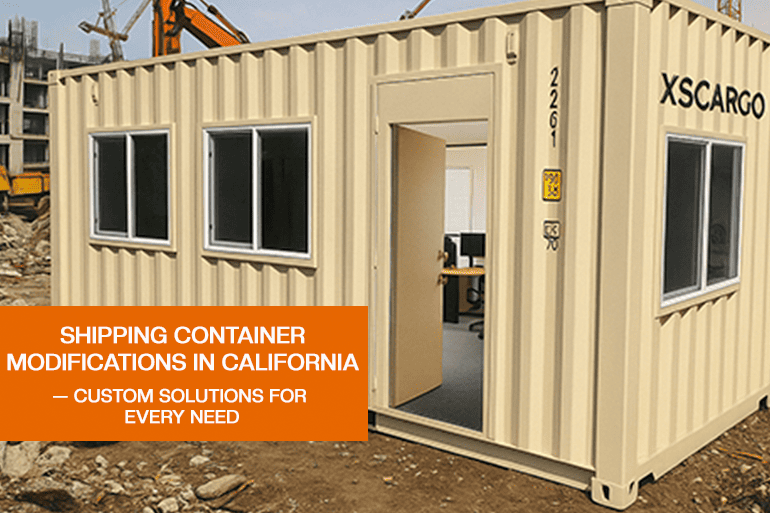
Construction managers commonly use container offices for on-site project management, secure storage of tools, and break rooms. A conversion typically includes insulation, HVAC, basic electrical, windows, and lockable doors — budgets vary from a few thousand dollars for a simple fit-out to tens of thousands for premium finishes. These containers are durable and secure, and their portability is ideal for sequential job sites.
Use Case 2 — Pop-up retail and mall activations
Containers work well for temporary retail or seasonal activations: they’re modular, brandable, and easy to ship between locations. California events (festivals, seasonal markets) often use temporary use permits — organizers should check local temporary use/parking rules. Santa Barbara and other coastal cities publish temporary use permit guidance for short-term commercial activities.
Use Case 3 — Food & beverage (container cafes and kitchens)
Modified containers can be used as quick-serve cafés, coffee bars, or ghost-kitchen units. These require additional permitting (health department, grease/waste management, potentially plumbing and ventilation) and often higher fit-out costs for kitchen equipment. Consult local county health department rules early in planning. (Costs for kitchen-grade modifications can grow substantially vs a simple office fit-out.)
Use Case 4 — Event spaces and experiential marketing
Brands use containers as immersive experiences (exhibit booths, VR demos, intimate performance stages). Their portability and robust shell are ideal for short-term activations that require security and quick setup.
Use Case 5 — Secure on-site retail storage & distribution hub
Retailers and e-commerce businesses use containers as last-mile storage and micro-fulfillment points. Insulation and humidity control improve lifespan of stored goods.
Use Case 6 — Studio / creative workspace
Musicians, photographers, and small studios use modified containers for affordable workspaces — typically adding soundproofing, HVAC, and electrical. High-cube containers are popular here for extra ceiling height.
Use Case 7 — Agricultural & farm usage (cold storage, packing stations)
Containers become cold rooms or packing stations when insulated and fit with refrigeration, especially useful for California’s farm and orchard operations.
Use Case 8 — Classrooms, training rooms & nonprofit uses
Nonprofits and schools sometimes use containers as supplementary classrooms or training hubs — check local school district and state building codes; temporary use permits may be required.
Use Case 9 — Retail kiosks on main streets & mixed-use developments
With municipal buy-in, containers can animate unused lots into retail corridors, especially when paired with community placemaking initiatives.
Use Case 10 — ADU & tiny dwelling (where permitted)
Some Californians repurpose containers as small dwelling units or ADUs; however, these usually trigger full building code compliance and require permits, utilities hookups, and thorough inspections. See separate guidance on ADUs in California when exploring residential conversions.
Common modification checklist (short)
- Insulation & vapor barrier (important for California coastal humidity).
- HVAC or mini-split units for comfort.
- Electrical with GFCI, lighting, and dedicated circuits for equipment.
- Windows & doors, roll-up doors for retail access.
- Flooring upgrades (marine plywood, laminate).
- Fire safety: smoke detectors, exit signage, and, if occupied, compliance with local codes.
Budget bands (illustrative ranges)
- Basic office conversion (20′): low thousands to mid-$10k depending on finish.
- Retail/food kiosk: mid-$10k to $50k if kitchen equipment is included and permits increase scope.
3 Replies to “10 Creative Ways Businesses Use Modified Shipping Containers (Offices, Retail, Events)”
Barret451
13 Dec 2025https://shorturl.fm/giM25
wr777app
22 Sep 2026The app version is so convenient for playing on the go. No lag and very secure transactions. Try wr777app today!
bd002win
01 Oct 2026Had a blast playing here this weekend. The community is friendly and the game mechanics are fair. I will be coming back to bd002win